
Greenup County Court Records After a Jail Arrest
A Greenup County arrest usually begins with a sheriff's deputy, city police officer, Kentucky State Police trooper, warrant service, or court order. Booking at the Greenup County Detention Center is the custody step. Court records begin when a case is opened in Kentucky District Court or Circuit Court and a prosecutor files, amends, dismisses, or pursues charges. That distinction matters because a jail booking charge is an intake label, while the court file is the official record of prosecution.
For current custody, use jail inmate records, the detention center phone line, VINE, and KOOL where appropriate. For booking photographs, use jail mugshots and the open-records process. For the case itself, move to Kentucky Court of Justice dockets, KYeCourts guest access, the Greenup Circuit Court Clerk, and the prosecutor offices serving Greenup County.
District Court and Circuit Court After Arrest
Kentucky separates criminal cases by court function. District Court commonly handles misdemeanors, violations, traffic matters, ordinance cases, arraignments, and felony probable-cause stages. Circuit Court handles felony indictments and serious felony prosecutions. Greenup County court business is tied to the Kentucky Court of Justice Greenup page and the Greenup County Courthouse Annex, where the Circuit Court Clerk's office is the starting point for official case copies.
The clerk's office is listed with weekday public hours and published phone numbers. Research also notes that older records may be stored in the clerk's office, transferred to a record facility, or destroyed under retention schedules. If a record is stored, the clerk can identify the facility and case or file locator information needed for the next request.
Search Court Records After a Greenup County Arrest
The Kentucky Court of Justice docket search is the first online stop when a hearing date is known. The docket is not the official case file, and the portal warns that docket information is subject to change. It is still useful for matching a recent jail arrest to a court date, division, courtroom, defendant name, charge language, and next hearing setting.
The official docket search form is available from the Kentucky Court of Justice docket search.
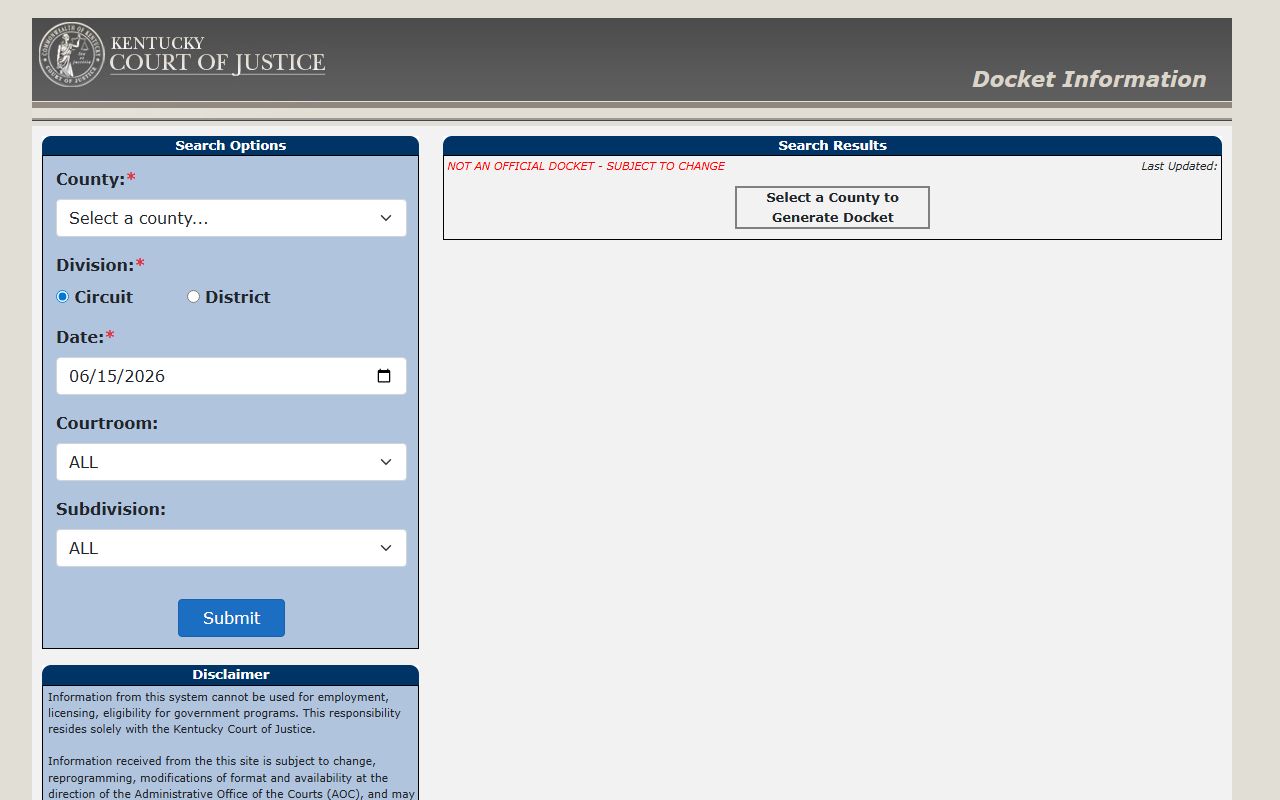
The form is useful because it starts with county, division, and date instead of assuming that a jail booking record is the same thing as the filed court case.
| Field Label | Type | Required | Greenup Use |
|---|---|---|---|
| County | Dropdown | Yes | Select GREENUP from the Kentucky county list. |
| Division | Selection | Yes | Choose District for many first appearances and misdemeanors, or Circuit for felony proceedings. |
| Date | Date field | Yes | Use the hearing date from jail, bond, clerk, or prosecutor information. |
| Courtroom | Dropdown | No | Leave as ALL unless the clerk or notice gives a courtroom. |
| Subdivision | Dropdown | No | Leave as ALL unless a specific docket subdivision is known. |
Charging Documents Filed After an Arrest
After arrest and booking, the charge record depends on the formal document used in court. The exact label may vary by case type and stage, but the important point is that prosecution choices can change the initial jail language. Prosecutors may amend a charge, reduce it, dismiss it, add another count, or present a felony matter to a grand jury for indictment.
| Document | Usually Connected To | Why It Matters |
|---|---|---|
| Complaint or citation | Initial District Court filing, misdemeanor, violation, traffic, or early felony stage | Starts the court record and may summarize probable cause or alleged facts. |
| Information | Prosecutor-filed charge where allowed by procedure | Shows the charge the prosecutor is choosing to pursue. |
| Indictment | Felony prosecution after grand jury action | Moves the serious felony charge into Circuit Court prosecution. |
| Amended charge document | Reduced, corrected, added, or changed counts | Explains why docket charge language may differ from the booking charge. |
Prosecutors for Greenup County Court Records
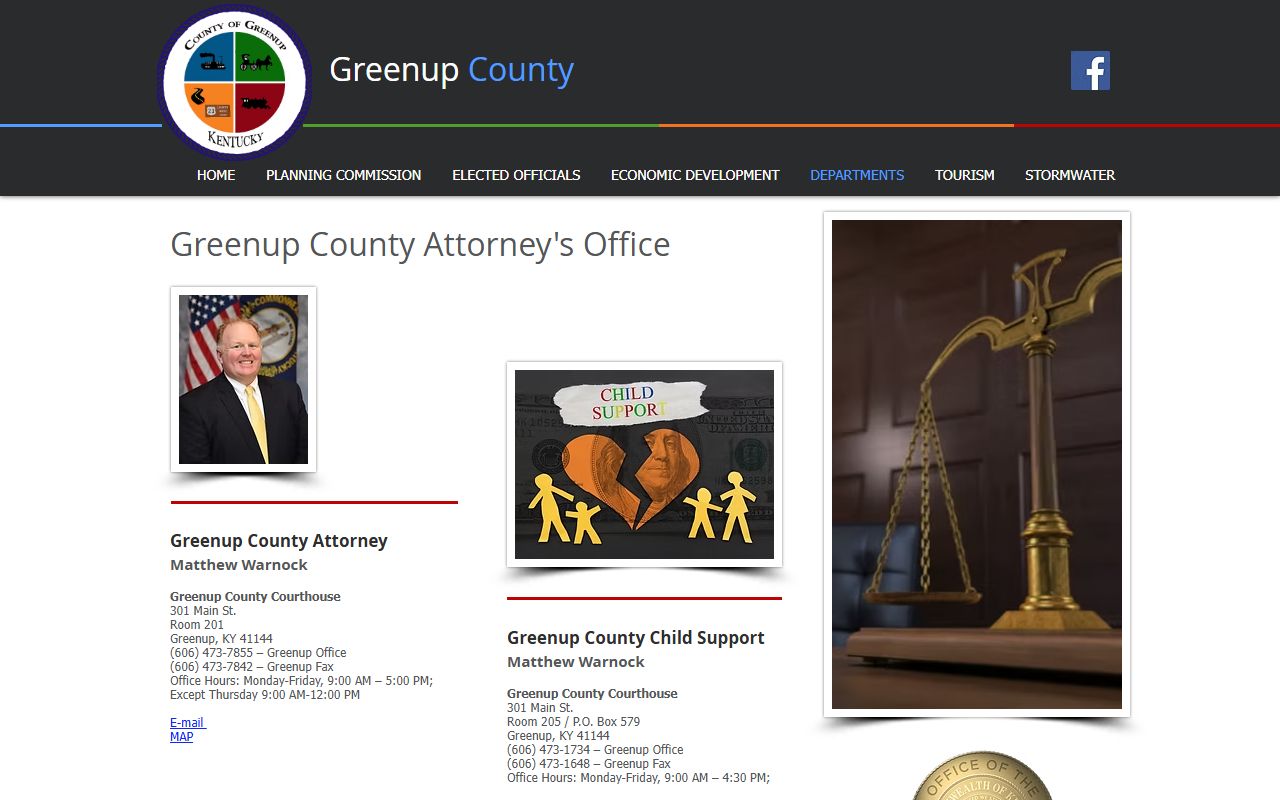
Kentucky does not use the title district attorney for Greenup County. The Greenup County Attorney handles misdemeanor and local District Court prosecution along with county legal functions. The official county page lists County Attorney Matthew Warnock at the Greenup County Courthouse, Room 201, with weekday hours that close at midday on Thursday.
The county attorney information is published on the official Greenup County Attorney page.
Felony and Circuit Court prosecution is handled by the 20th Judicial Circuit Commonwealth's Attorney. The Kentucky Attorney General directory lists Rhese McKenzie as Commonwealth's Attorney for Greenup and Lewis counties. Prosecutor records do not replace clerk records, but prosecutor action explains why an arrest charge may become a different filed charge.
| Office | Typical Role | Greenup Research Detail |
|---|---|---|
| Greenup County Attorney | District Court prosecution, misdemeanor/local matters, juvenile and other listed county functions | Matthew Warnock; courthouse office; public phone and fax listed by county sources. |
| 20th Judicial Circuit Commonwealth's Attorney | Felony and Circuit Court prosecution | Rhese McKenzie listed for Greenup and Lewis counties by the Kentucky Attorney General directory. |
| Circuit Court Clerk | Official case records and copies | Allen Kent Reed listed by Kentucky Court of Justice for Greenup County court records. |
Charge Status in Court Records After Arrest
Charge status is the part of the court record that prevents confusion. A person can be arrested on one description, arraigned under a related count, indicted on a different felony count, or later have a charge dismissed. The docket and clerk file should be checked for the current status before relying on older jail language.
| Status | Meaning | Practical Caution |
|---|---|---|
| Pending | The charge remains open and has not reached final disposition. | Check the next hearing date and any bond or warrant entries. |
| Amended or reduced | The prosecutor or court changed the charge language, level, or count. | Do not treat the booking charge as final. |
| Dismissed | The charge was ended without conviction on that count. | Other counts in the same case may still remain. |
| Indicted | A grand jury returned a felony charging document. | The case may move from early District Court activity into Circuit Court. |
| Disposed | The charge reached a plea, verdict, dismissal, or other final result. | Read the disposition rather than only the charge title. |
Bond and Release After a Jail Arrest
Greenup County official jail pages do not publish bond-posting hours, accepted payment methods, or an online detention-center bond portal. The practical route is to confirm custody and bond status with the Greenup County Detention Center, then confirm court payment procedure with the Greenup Circuit Court Clerk when the case has reached court. A paid bond may still not produce release if another hold, detainer, parole/probation issue, federal matter, or ICE issue exists.
| Bond Type | How It Works | Greenup Research Note |
|---|---|---|
| Cash bond | The full amount is posted as ordered. | The official jail source did not publish accepted bond methods. |
| Surety bond | A licensed bail agent guarantees appearance. | Commercial bail remains part of Kentucky practice. |
| Property bond | Real property may secure release if the court allows it. | The clerk or court must confirm local requirements. |
| PR bond | Release on a promise to appear, sometimes with conditions. | Set by the court or pretrial process, not by a roster page. |
| No-bond hold | Release is not allowed unless a court changes the order. | Can arise from warrants, serious charges, or outside holds. |
Warrants That Lead to Arrest and Court Records
No official Greenup County online active-warrant search was located in the county, sheriff, or court sources reviewed. The sheriff's office states that deputies serve judicial notices, arrest warrants, and other statutory duties. A warrant may lead to booking at the detention center, but the reason for the warrant often belongs in the court file.
| Warrant Type | What It Means | Where to Verify |
|---|---|---|
| Arrest warrant | A court order to bring a person into custody on a criminal matter. | Sheriff procedure questions, court clerk, and docket records. |
| Bench warrant | Often tied to missing court or violating a court order. | Court clerk and the underlying case file. |
| Search warrant | Authorizes a search, not automatically a custody booking. | Court records if public and not restricted. |
| Fugitive warrant or hold | Another jurisdiction requests custody or return. | Jail, court, and the requesting agency. |
Charges vs. Convictions in Court Records
An arrest and a filed charge are accusations, not convictions. A conviction requires a guilty plea, verdict, or other final adjudication. Public court records may show both charges and final dispositions, so the outcome column matters as much as the charge title.
| Charge | Conviction | |
|---|---|---|
| Stage | Accusation filed or pursued after arrest. | Final result after plea, verdict, or adjudication. |
| Proof level | Often tied to probable cause or charging decision. | Requires the criminal-case standard for guilt. |
| Where found | Docket entries, complaint, citation, information, or indictment. | Disposition entry, judgment, sentence, or final order. |
| Common mistake | Treating a booking charge as final. | Ignoring dismissed or amended counts. |
AOC FastCheck and Criminal Record Reports
Kentucky Court of Justice provides AOC criminal record reports through FastCheck for registered users and a One-Time Request process by mail. The research source says report contents include misdemeanor and traffic cases for at least the last five years and felonies dating back to 1978. Confidential case types such as juvenile, mental health, and domestic violence cases are excluded, and AOC reports do not contain federal information.
FastCheck is not the same as a docket search. A docket helps follow a hearing schedule and case activity. AOC reports summarize qualifying Kentucky criminal history after processing. Third-party requests are allowed, but when a record is found, the AOC notifies the person and sends them a copy.
Sealed vs. Expunged Arrest and Court Records
Kentucky public-access rules start with open examination of public records, but court records can be restricted by juvenile confidentiality, sealed proceedings, expungement, investigatory limits, and other lawful exceptions. KRS 431.073 is the research-cited felony conviction vacation and expungement statute. Eligibility depends on the charge, result, waiting period, and court order.
| Sealed | Expunged | |
|---|---|---|
| Public visibility | Hidden or restricted from ordinary public access by court order. | Removed or treated according to the expungement order. |
| Best source | The clerk and the sealing order. | The court record and expungement order. |
| Common limits | Some agencies may retain limited authorized access. | Internet copies and third-party republication may require separate action. |
| Greenup action | Verify with the Greenup Circuit Court Clerk. | Use the Kentucky court expungement process where eligible. |
Open Records, Restrictions, and Case Copies
KRS 61.871 states Kentucky's policy favoring free and open examination of public records with exceptions strictly construed. KRS 61.872 recognizes written public-record requests by hand delivery, mail, fax, or email. Those statutes help when a booking sheet, agency record, or communications record is not available through routine channels.
Access note: Court records, jail records, prosecutor records, and dispatch records can have different custodians. Juvenile matters, sealed files, ongoing investigations, safety issues, and confidential case types may limit release.
For dispatch and CAD context around an arrest, Greenup Public Safety provides an open-records form for CAD entries, call replay, and radio traffic. For official court case copies, the circuit court clerk remains the better starting point. For custody status, the jail and VINE are more direct than a docket.
Public Record Search
Sponsored Results